Monthly Archives: February 2018

Shawn Brown’s image selection and reflection


My name is Shawn Brown. I chose this image for numerous reasons. In this picture, I see a man full of love, grace, and a desire to lead people. I also observe a man repressing several emotions to remain joyful in the face of adversity by way of racism. I have had similar experiences and sentiments as a Principal. I in no way can relate to the level of scrutiny that he must have endured. As a Black man, we are under surveillance at all times. There is no way of being that will satisfy the desires of the masses. His compassion is considered a weakness. When he is passionate or focused on a specific goal he’s deemed to be dangerous. When positioned in such a restrictive manner one is left to surrender and smile. I see a sense of surrender and silent determination. Grinning is a universal symbol used as a defensive mechanism for many Black men. Barry also understood the rules of engagement for holding the world’s most important position. This image encourages me to remain resilient in the face of trials.


Regina’s Reflection

The photo I shared with the class last week was of my students. It was taken during field day at the end of September.  Before this day, these students weren’t friends with each other but they came together for this pyramid.  I love the picture because I see so much joy in them. They’re all just a bunch of weirdos that found each other!  Plus, it’s nice to see my students as they are–instead of as a series of data and standards, struggles and strengths.

I spoke in class about how I might be more comfortable producing writing-based art for this class.  I envisioned writing poems around a certain topic. It made me happy to see Barone and Eisner mention Death of a Salesman and The Godfather as examples of arts-based research.  And while I realize that these might not be where the field is in 2018, I still feel drawn to creative writing.

Over the last two years I have been doing archive research about Jack Kerouac. My plan for my thesis was to combine all my papers about him into one big… thing. Recently, I’ve been tooling with idea of doing something less straight-forward.  Maybe making a graphic novel biography about him? Maybe writing a young adult historical fiction story about him? I have a lot of ideas! I think it would be nice to explore these ideas in this class and see where they take me.

Amanda’s reflections on readings and themes to explore

I found this week’s readings to be validating to me about how I think about education. I work as an educator at a non profit doing community organizing. I run our fellowship program on community organizing and much of my work is to think about how we become politicized through our lived experiences and what it means for lived experiences to be the starting point of curriculum. Eisner helped me see how art can help us understand the world around us with many of the same tools that make our experiences meaningful; I found it interesting how he talked about knowledge that comes from senses, emotions, and nuances. Art is a way for us to portray something about our experiences that traditional research can’t.

For many years I’ve been interested in the ideas of Paulo Freire. Freire was a critical educator that did a lot of work around literacy. One of the tools he used to spark conversation, critical thinking and eventually literacy was art and images. He worked with a team of researchers and community members in rural Brazil to talk with people about their lives and what was important to them. Then their team developed these experiences and the themes they represented into images. The literacy classes started with community members discussing the images that reflected back to them what they had told the research team about.

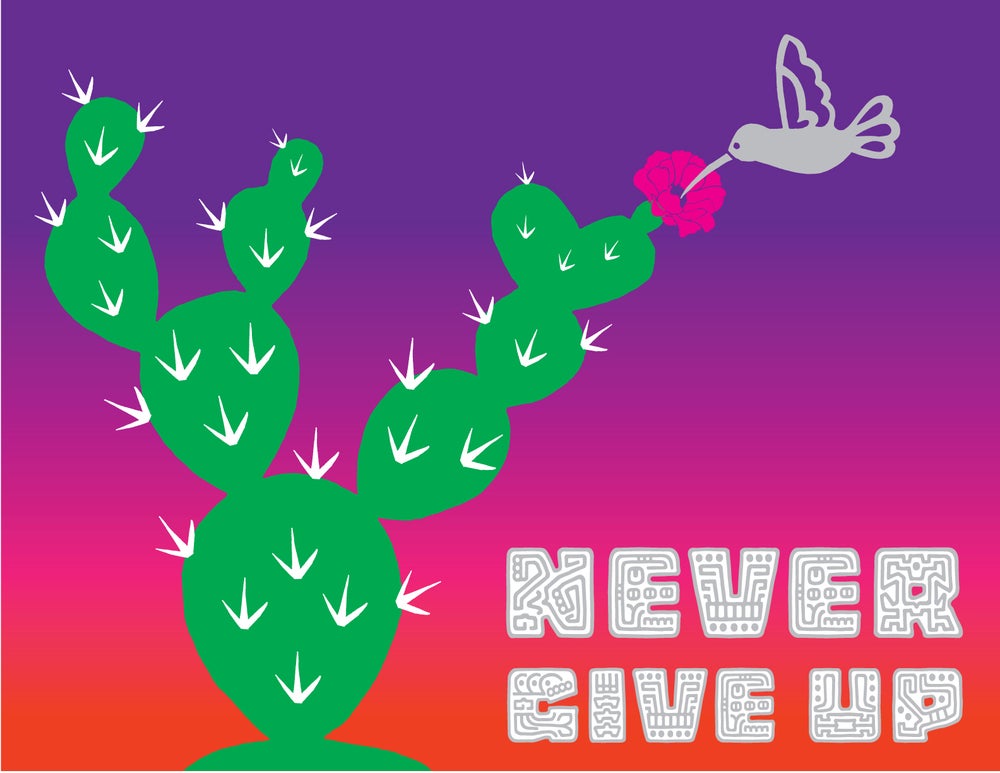
In my education work, I’m curious how I can use images in our curriculum to cultivate critical thinking that grows out of our lived experiences. In this class, I hope to explore some of my own experiences dealing with illness and family through thinking about roots and struggle. What can we learn from images about how roots are strengthened and sustained through death, through displacement, through distance? What grounds us and allows us to survive and perhaps thrive even through the most difficult things we face both through the nature of being mortal and because of systems of oppression that wrench people from place? I’ve attached an image by Melanie Cervantes of the artists’ collective, Dignidad Rebelde. As it says on their website, “Dignidad Rebelde is a graphic arts collaboration between Oakland-based artists Jesus Barraza and Melanie Cervantes.” I chose this image because it makes me ask myself the question: in the hardest times, what nourishes us? In struggle, what do we learn about our roots? How do we find them and redefine them?

Image of Never Give Up (2017)

Reading reflection (Anna)

Both readings for this week appealed to my senses in emotional and intellectual capacity. I have recently experienced this with a lot of the readings, when I feel that every article/chapter adds to my existing collage of theories, each representing a puzzle piece that has been missing. Having found this new puzzle piece, I feel an incredible joy for placing it in the right spot (if there is such a thing) of a larger mosaic entitled something like “My Theoretical Frameworks/My Epistemology/My World View.”

I am going to pause in this reflection on the idea of heuristics and how both of the readings used the concept of heuristics to explain the need for arts based research. “In a sense, arts based research is a heuristic through which we deepen and make more complex our understanding of some aspects of the world,” wrote Barone and Eisner (2012) as they argued that each arts based research project aims to create a form that is evocative and compelling to the viewers and invites us to contemplate an issue (issues) introduced by the research project  (Barone and Eisner, 2012, p. 3). In the second piece, Eisner talked about the concept of generalizability as a heuristic, as he addressed both quantitative and qualitative research in education. “The generalizations derived from qualitative case studies are essentially heuristic devices intended to sharpen perception so that our patterns of seeking and seeing are more acute. We don’t use the generalizations drawn from the specific case to draw conclusions about other situations but, rather, we use them to search those situations more efficiently” (Eisner 2001, p. 141). I have been intrigued by the idea of using heuristics as a tool, or as Eisner puts it “a heuristic device”, in conducting research and creating opportunities for reflection and transformation, and it is interesting, although not surprising, to see that in arts based research the projects can be used as a heuristic to do the investigative and exploratory work.

My final thought is also based on the reading, where Barone and Eisner (2012) quoted Gombrich who said: “Painting is an activity and the artist will therefore tend to see what he paints rather than paint what he sees,” which makes me realize that as I create my collage of theories, I will inevitably see the puzzle pieces that fit into my epistemology. As I go on this journey of creating an art based research project, the process of creation will be based on seeing what I create, as I learn from my creation what it is that I am actually seeing. 

Researching Identity through Art Dora’s Journal Entry 1

This is one of the many paintings by my son Daniel. Daniel has high functioning autism and lives pretty much inside his head. He suffers from auditory integration dysfunction, so expressing himself verbally as well as in written form is extremely difficult for him. Art gives him an outlet he cannot find otherwise.

He paints and sculpts self-portraits. He started painting one face but has progressed to three faces in one. He has never discussed the reason for that number and I do not know if he is aware of this particularity. Daniel is conscious that people see him as different. I wonder if through his self-portraits he’s trying to perpetuate or re-create his self-identity. Anderson (2015) views identity narratives as fluid.  Art may offer Daniel the fluidity needed to re-create his identity without making him too vulnerable to the outside world. The three faces may be the different identities he perceives in himself. Varela (1999) discusses the interweaving of microwords (our immediate context) and microidentities (who we are at an immediate moment, in an immediate context). Daniel seems to want to explore and understand his microidentities.

Creating a project around Daniel’s exploration of his microidentities sounds exciting but I would feel that I’m intruding in his private world.


Instead, I can explore the identity of Latin Americans as we struggle to come to terms with the fact that we embody two or three races, races that represent, in the words of Freire (1970), the oppressed and the oppressor. I want to investigate how Latin American artists have explored this issue and how it translates into the visual arts. Kahlo’s Two Fridas embodies the concept of who we are as a pueblo but does not illustrate the inner turmoil we suffer because our oppressed identity has been portrayed as lacking, while the oppressor identity has been equated with superiority.


Nick’s Photo and Thoughts on Readings

This is the image I was going to share in class because it is the one photo I always go back to on my phone and it makes me happy. I took the image while playing with my daughter in my backyard. I’m not sure why I prefer this photo to others of my daughter, but I do like it.

When I think about my own investigation and final project, I think I want to incorporate some mixed media (music and art or music and photograph) in order to bring attention to a social justice issue.

Thoughts on the readings

This week’s readings, (Eisner, 2001) and (Barone & Eisner, 2012) focused on the meaning behind arts based research, as well as an understanding of the benefits of qualitative research methods. Arts based research provides nuance and expression that helps provide a more complete empathetic understanding of a situation and personal emotions. It invites discourse and embraces difference which hopefully leads to greater understanding and growth. In many educational institutions, the focus on quantitative data and test scores have undermined the holistic learning process that arts based research attends to. A greater consideration for the qualitative research methods might re-orient creativity and nuance as virtues in our society.

I am particularly drawn to the idea of art created to serve a specific purpose, instead of the creation of art for art’s sake. There appears to be an ethical consideration in this type of art, a determination to open dialogue, shine a light on what would otherwise remain obscured, challenge one’s way of thinking, embrace discourse, and contribute to a social beneficence that appears to align closely with the tenets of Authentic Inquiry (Tobin, 2017). Barone and Eisner write, “arts based research is a heuristic through which we deepen and make more complex our understanding of some aspect of the world”.  Art created to invite the viewer towards a metacognition of issues that might otherwise be hidden from the self.

Anna’s image/idea for the project

When I first took this picture, as I walked behind my children, I thought to myself, “There they go, walking away from me.” Emotions, according to Jonathan Turner (2002), are often mixed with each other and the result is not always as straightforward as it may seem at first glance. Happiness mixed with sadness will produce emotions like nostalgia, which is exactly what happened in this moment for me, when I felt both happy and sad to watch my children go (literally and figuratively). As we looked at this image together in class and as Gene talked about it, proposing for me to sift through my images looking for a pattern, I realized that I remember a few other pictures of my children walking together, which I took. I guess I like to capture moments of them walking, caught in an instant, taken without their awareness of it. I am intrigued by this idea and will go through my images to see if that could sum up to some kind of a project. I have already been quiet inspired by you all and am looking forward to seeing other images from the classmates who didn’t get to share on Wednesday.